? July 25, 2010
July 27, 2010 ?
July 26

| Wikinews Audio Briefs Credits |
|---|
| Produced By |
| Turtlestack |
| Recorded By |
| Turtlestack |
| Written By |
| Turtlestack |
| Listen To This Brief |
Problems? See our media guide. |

Read An Opinion On:
byadmin
Whether someone is building a home or they simply want to give their current home a new look, investing in top-quality siding is important. Companies that do installation and siding repair in Charles MO know there are a variety of options available, but none match the durability of vinyl siding. Today’s contractors are here to point out some of the benefits of residential vinyl siding. For those considering the investment, below are some of the reasons why vinyl siding comes so highly recommended by contractors and homeowners alike.
Cost Savings
If a person is concerned about their budget, vinyl siding can be more cost-efficient than fiber cement or natural wood siding. In most cases, vinyl siding is about half the cost of other materials. Furthermore, because it’s easier to install, the customer spends less on labor during the process of installation.
Durability
One of the main benefits of vinyl siding is that it is much more durable than other siding options. Unlike wood siding, which can gradually rot, vinyl siding is not affected by water and it is made to stand up to the elements. Most vinyl siding offered by local contractors comes with an extensive warranty for additional peace of mind.
Energy Efficiency
Many of today’s homeowners are concerned about the home’s overall energy usage. Investing in insulated siding can provide the owner with hundreds of dollars in energy savings each year. Certain kinds of energy-efficient vinyl siding may also make a homeowner eligible for rebates and discounts as well.
Low Maintenance
Some homeowners prefer to invest in vinyl siding because of its easy care and low maintenance. It is highly pest resistant, and it does not rot, crumble or fade with time. The only maintenance it generally needs is the occasional treatment with a pressure washer.
To find out more about the advantages of vinyl siding installation and Siding Repair in Charles MO, call the local pros. They specialize in siding repair, roofing repair and installation, decks, patio covers and more. Be sure to visit the website or contact us to learn about all their services or to schedule an appointment.
Friday, October 2, 2009
Companies in the United States are shedding more jobs, pushing the country’s unemployment rate to a 26-year high of 9.8%.
The US Labor Department said on Friday that employers cut 263,000 jobs in September, with companies in the service industries — including banks, restaurants and retailers — hit especially hard. This is the 21st consecutive month of job losses in the country.
The United States has now lost 7.2 million jobs since the recession officially began in December 2007. The new data has sparked fears that unemployment could threaten an economic recovery. Top US officials have warned that any recovery would be slow and uneven, and some have predicted the unemployment rate will top 10% before the situation improves.
“Continued household deleveraging and rising unemployment may weigh more on consumption than forecast, and accelerating corporate and commercial property defaults could slow the improvement in financial conditions,” read a report by the International Monetary Fund’s World Economic Outlook, predicting that unemployment will average 10.1% by next year and not go back down to five percent until 2014.
Mark Zandi, chief economist at Moody’s Economy.com, said that “it’s a very fragile and tentative recovery. Policy makers need to do more.”
“The number came in weaker than expected. We saw a lot of artificial involvement by the government to prop up the markets, and now that that is starting to end, the private sector isn’t yet showing signs of life,” said Kevin Caron, a market strategist for Stifel, Nicolaus & Co.
Also on Thursday, the US Commerce Department said factory orders fell for the first time in five months, dropping eight-tenths of a percent in August. Orders for durable goods — items intended to last several years (including everything from appliances to airliners) — fell 2.6%, the largest drop since January of this year.
The US government has been spending billions of dollars — part of a $787 billion stimulus package — to help spark economic growth. There have been some signs the economy is improving.
The Commerce Department said on Thursday that spending on home construction jumped in August for its biggest increase in 16 years. A real estate trade group, the National Association of Realtors, said pending sales of previously owned homes rose more than 12 percent in August, compared to August 2008.
A separate Commerce Department report said that consumer spending, which accounts for more than two-thirds of US economic activity, rose at its fastest pace in nearly eight years, jumping 1.3 percent in August.
Other reports have provided cause for concern. A banking industry trade group said Thursday the number of US consumers making late payments, or failing to make payments, on loans and credit cards is on the rise. A survey by a business group, the Institute for Supply Management, Thursday showed US manufacturing grew in September, but at a slower pace than in August when manufacturing increased for the first time in a year and a half.
Stock markets reacted negatively to the reports. The Dow Jones Industrial Average fell 41 points in early trading, reaching a level of 9467. This follows a drop of 203 points on Thursday, its largest loss in a single day since July. The London FTSE index fell 55 points, or 1.1%, to reach 4993 points by 15.00 local time.
Tuesday, April 27, 2010
Dale Ogden, a 2010 California gubernatorial candidate, talks with Wikinews reporter Mike Morales about his platform.
Ogden is a member of the United States’ Libertarian Party.

Read An Opinion On:
byAlma Abell
Vacations in and around Rocky Mountain National Park can be relaxing. They can also be filled with a myriad of events and things to experience. In fact, between nearby Grand Lake and Rocky Mountain National Park attractions can occupy you physically, emotionally and sensually no matter in what season you arrive. This entire region of Colorado is a smorgasbord of delightful adventures waiting to happen.
Attractions in Rocky Mountain National Park
Rocky Mountain National Park is one of the state of Colorado’s “Crown Jewels.” Since 1915, it has wowed the visitors with its natural beauty. With 265,769 acres to explore, the park is a naturalist’s dream. It is home to 900 species of plants as well as 281 types of birds and 60 species of mammals. The park offers various children’s program.
Visit any of the five visitor centers. They offer Ranger-led programs as well as interactive exhibits, life-sized wildlife displays and interpretive programs. Come to enjoy the Park on special event days or plan to visit any of the historic sites in the Park. The Holzwarth Historic Site (a trail and early ranch/homestead) and the remains of the 1880 silver mining town of Lulu attract visitors who want to catch a glimpse of early Colorado history.
Yet, the biggest of all the Rocky Mountain National Park Attractions remains the mountains and the trails that run through them. The Park boasts some of the state’s highest peaks. You can climb and hike up to the peak of Longs Peak or Lumpy Ridges. Gaze out over a landscape that embraces more than 100 lakes, lush wetlands, pine, fir and spruce forests and alpine tundra.
Attractions in Grand Lake
While the Rocky Mountain National Park is one of the major attractions that bring visitors to Grand Lake, it is not the only one. Grand Lake has its own. Throughout the year, special events commemorate the community, the state and the country. Visit during the Winter Carnival in January or take part in the Arts and Crafts Fair in the summer. Throughout the year, visitors can enjoy the beauty that surrounds the town. Visit the Kauffman House Museum and discover local and regional history.
Natural wonders abound in Grand Lake. Yet, visitors and locals also enjoy the other every day attractions. Come visit any of the many restaurants and shops that line the Grand Avenue. Walk the historic wood boardwalk. Grand Lake is about providing its guests with attractions that make for a rounded experience.
Rocky Mountain National Park Attractions
If you plan a visit to Colorado, do not ignore some of its greatest assets. Be sure to visit the Rocky Mountain National Park. Attractions here and in nearby Grand Lake combine the wonders of nature with human activities. The result is a wonderful experience for every member of the family.
18 December 2004
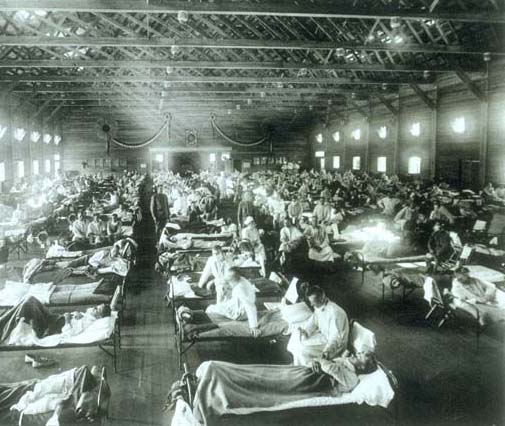
Emergency hospital during 1918 influenza epidemic, Camp Funston, Kansas (source: National Museum of Health and Medicine, AFIP).
A bout of the flu can be mild. In young, healthy adults, many infections pass unnoticed. But sometimes the influenza virus evolves into a strain that decimates its victims. The worst known strain swept the world in the Fall of 1918, infecting 500-1000 million and killing 40-100 million, about 2-5% of people.
There are several theories about where the pandemic began, but the likeliest origin was in Haskell County, Kansas, in the United States. People in the sparsely populated county, where farmers raised pigs, poultry, cattle, and grain, began suffering from influenza in late January 1918. Unusually for flu, it was young, healthy adults who were hardest hit. Victims fell ill suddenly, many progressing to pneumonia and dying, often within days. Within weeks, however, the epidemic ended. The natural geographic isolation of this community normally might have contained the fatal flu in a sort of unintentional quarantine, but the First World War intervened. Men were uprooted from their home towns and congregated in huge numbers in army camps for training and then shipping out to other camps or to fight in Europe. The destination for men from Haskell County was Camp Funston, part of Fort Riley, Kansas, where the first influenza case was reported in early March. As soldiers moved among camps, the virus spread. Within two months, the epidemic spread to most of the army camps and most of the largest cities in the United States. As American soldiers went to France, so did the virus, spreading first from the port of Brest.
The flu then spread worldwide. The pandemic reached its height in the Fall of 1918. Spain was affected early, and because Spain was not fighting in the World War, there was no wartime censorship, and news of the outbreak became widely known, leading to the flu being called the Spanish Flu in many countries. In Spain, however, it was called French Flu or the Naples Soldier. In India, about 12 million people died of flu. In some US cities, people died so quickly that morticians couldn’t cope with the bodies. According to Jessie Lee Brown Foveaux, who worked in the Fort Riley laundry during the epidemic: “They were piling them up in a warehouse until they could get coffins for them.”
The disease started with cough, then headache. Temperature, breathing and heart rate increased rapidly. In the worst cases, pneumonia came next, the lungs filling with liquid, drowning the patients and turning them blue from lack of air. Patients bled from every orifice: mouths, noses, ears, eyes. Those who survived often suffered temporary or permanent brain damage. Several million developed encephalitis lethargica, in which victims were trapped in a permanent sleeplike and rigid state, as portrayed in the 1990 movie “Awakenings.” In others, normal thought processes were impaired. During negotiations to end World War I, US President Woodrow Wilson was struck with flu, and people around him noted that his mental abilities never fully recovered. The French leader George Clemenceau had wanted harsher punishment of Germany than Wilson had desired. Clemenceau may have convinced Wilson in his weakened state to accept such harsh terms, which may have been one of the factors causing World War II.
Since flu is highly contagious early in the illness, even before symptoms appear, strict quarantine may be necessary to stop its spread during an epidemic. Australia kept its 1918 flu death rate relatively low by enforcing quarantines. However, in many parts of the world, public health officials hesitated to impose such measures, giving the disease time to gain a foothold. In the US city of Philadelphia, a rally of half a million people was planned in September 1918 to sell bonds to fund the war, at just the time when the flu started to infect residents. Although doctors warned the public health director to cancel the rally, he wanted to meet the city’s quota to raise money for the war and refused to cancel the event. Within days after the rally, half a million city residents caught the flu.
Why was the 1918 flu so deadly? The influenza virus wasn’t preserved at the time of the outbreak, at least on purpose. But in the late 1990s researchers Ann Reid, Jeffery K. Taubenberger, and their colleagues extracted and sequenced the genetic material of the virus, RNA, from tissue of victims who died in the pandemic. They used bits of lung that were preserved in formalin from victims on army bases or from victims buried in permafrost in the Alaskan village of Brevig Mission, where flu killed 85% of adults. Comparisons with known flu viruses in humans, pigs, and birds suggest that some genes of the 1918 virus came from birds or an unknown animal source. Other scientists then were able to show that the amino acid sequence of hemagglutinin protein from the 1918 virus had several changes from other flu viruses that may have helped it to easily bind and invade human cells, and that made the virus look different enough from earlier flu virus strains that people had no immunity.
The possibility exists that another flu pandemic will sweep the world like the one in 1918. In 2004, an H5N1 influenza virus has killed millions of birds and at least 30 people in southeast Asia. So far this virus strain has not evolved the ability to pass directly from human to human, but that possibility becomes more likely as the bird flu pandemic continues and humans remain in contact with chickens, ducks, and other birds. The virus has killed two-thirds of people reported to be infected. Dr. Tim Uyeki, an epidemiologist for the US Centers for Disease Control, says, “you have the ingredients in Asia right now for a public health disaster.”
But since sequences of this bird flu virus are known, it may be possible to develop a vaccine or set of vaccines to protect against it. At a special meeting of influenza experts on November 11th and 12th, World Health Organization influenza program chief Klaus Stohr said, “It is not only possible, but also important, that influenza pandemic vaccines be made available… and there’s a shared responsibility needed to make that happen…. We have a huge window of opportunity now.”
Update since publication
This article mentions that Wi-Fi stands for “Wireless Fidelity”, although this is disputed.
Thursday, July 7, 2005
A Florida man is being charged with 3rd degree felony for logging into a private Wi-Fi (Wireless Fidelity) Internet access point without permission. Benjamin Smith III, 41, is set for a pre-trial hearing this month in the first case of its kind in the United States.
This kind of activity occurs frequently, but often goes undetected by the owners of these wireless access points (WAPs). Unauthorized users range from casual Web browsers, to users sending e-mails, to users involved in pornography or even illegal endeavours.
According to Richard Dinon, owner of the WAP Smith allegedly broke into, Smith was using a laptop in an automobile while parked outside Dinon’s residence.
There are many steps an owner of one of these access points can take to secure them from outside users. Dinon reportedly knew how to take these steps, but had not bothered because his “neighbors are older.”
Thursday, January 13, 2005
The following stories made international headlines Thurssday:
One of the two NASA’s rovers roaming on planet Mars for over a year has stumbled upon a rock unlike any other previously seen: according to the machine’s instruments, the rock may be made out of metal. Scientists on the project suspect that the object is a meteorite, and are continuing to examine it with the rover’s other analysis and imaging tools.
Britain’s Prince Harry was photographed wearing a Nazi uniform, complete with swastika armband, while puffing on a cigarette at a costume party. The picture made the front page of London’s The Sun newspaper. The Prince’s father, Prince Charles, ordered Harry to visit Auschwitz to learn more about the Holocaust.
With two new cases of bovine spongiform encephalopathy confirmed over the past two weeks, Canada’s beef industry is reeling.
The White House admits that its two-year search for Iraqi weapons of mass destruction has ended. U.S. investigators came up empty handed in their search for WMDs, a main reason cited by the administration for the invasion of the Middle East country.

Read An Opinion On:
byAlma Abell
Many people automatically associate the word “cheap” with another word and that word is “nasty”. This gives rise to a reluctance to get involved with anything “cheap”. For example, if we see an advertisement telling us to buy Cheap Cabinets for our home we will automatically ignore it. We get a mental picture of shoddily made cabinets using very low cost, inferior, raw materials that have been badly put together; in other words, something that might be put in a cheap motel room but never in your own home!
If Cheap Is Nasty; What Is Economical?
If that same advertisement had been for economically priced cabinets; then, we would have read on with interest in the expectation of getting a bargain and saving ourselves some money. Other ways of implying a, lower than you expect price, include phrases like: “cost saving”; “discounted prices”; even “bargain prices”. Such phrases can lead you to believe that you are being offered a good quality product at an advantageous price and, assuming that it is a product that you currently have a use for, you will investigate further and, possibly, purchase it.
How Do Cheap Cabinets Vary From Economical Ones?
Although the possibility exists that they may not vary in price, Cheap Cabinets are unlikely to be made from genuine, natural (as sawn) wood. They are more likely to be covered with a cheap, self-adhesive plastic layer that has been colored to pretend to be a wood veneer surface and things like door hinges and shelf brackets will probably be of inferior quality. Additionally, the supplier might not provide any sort of warranty on your purchase.
If we are looking at cheap RTA (Ready To Assemble) cabinet kits, we are likely to face that most frustrating of DIY problems when an instruction manual does not match up fully with the contents of the kit. For example: – “Place part 1 into hole 2”; you have found part 1 but there is no sign of any hole 2 whatsoever!
If the economically priced alternative is manufactured by a reputable company and purchased from an equally reputable dealer – either online or from a warehouse or store – then you should not encounter the sort of problems that you could get from purchasing cheap cabinets.